 RE-ENERGY off-grid solar system Ballarat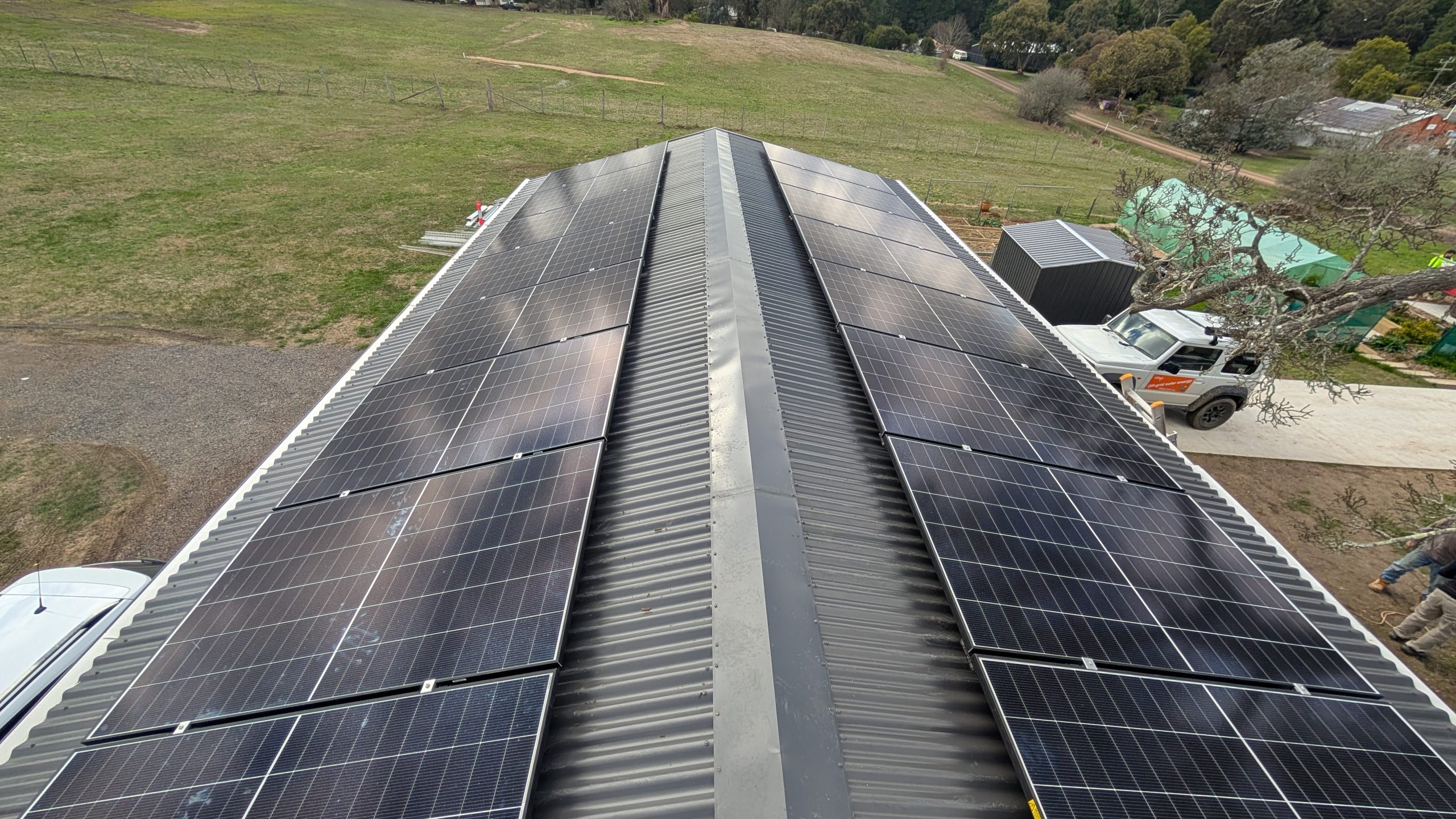
Designing a truly generator-less off-grid solar system in Ballarat and the Central Highlands requires a very different approach to warmer or sunnier parts of Australia.
Our goal is simple:
to design off-grid systems that can realistically operate without a generator in Ballarat conditions.
That means designing for:
- Cold winters
- Frequent cloud cover
- Short winter days
- Consecutive low-production periods
Not just best-case weather, and not just short-term occupancy.
Common System Scenarios for Ballarat Homes
To create reliable off-grid systems in Ballarat, we work from common household scenarios based on bedroom count and full occupancy, rather than minimum current usage.
We typically design reference systems for:
- 2-bedroom homes
- 3-bedroom homes
- 4-bedroom homes
- 5-bedroom homes
These are not fixed packages. They are design reference points that allow us to size systems appropriately for Ballarat’s winter conditions and long-term use.
Design Principle 1: Realistic Energy Demand
Our baseline energy assumption is:
- 5 kWh per day for an empty house, plus
- 5 kWh per day for each person living in the home
For example:
- A 2-bedroom home in Ballarat is typically designed for 2 occupants plus one additional person
- Larger homes are designed to support higher realistic occupancy
This avoids under-sizing systems based on short-term living arrangements or unusually low usage.
Why We Design for Full Occupancy in Ballarat
In Ballarat, off-grid properties are often:
- Family homes
- Long-term lifestyle properties
- Rural or semi-rural investments
Even if a home is currently occupied by fewer people, the energy system should comfortably support full household occupancy.
Living arrangements change — and many off-grid properties are eventually sold.
A system that only works for today’s occupants often becomes a liability later, especially in Ballarat where winter performance quickly exposes weak system design.
Off-Grid Energy and Property Value in Ballarat
For off-grid properties around Ballarat, the energy system is core infrastructure, not an optional feature.
When a Ballarat off-grid property goes on the market, buyers focus heavily on:
- Winter power reliability
- Generator dependence
- Battery capacity
- Whether the system can support a full household
An under-sized or generator-dependent system can:
- Reduce buyer confidence
- Limit the pool of potential buyers
- Lower perceived property value
A properly designed, generator-less off-grid solar system:
- Makes the property easier to sell
- Reduces concerns during inspections
- Avoids last-minute system upgrades
- Protects long-term property value
This is why we design systems with future owners in mind, not just current usage.
Design Principle 2: Redundancy Through Dual Systems
In Ballarat, redundancy isn’t optional — it’s essential for generator-less operation.
Where practical, we design systems with:
- Dual inverters
- Distributed battery banks
If a component fails, the system can continue operating while repairs are arranged.
Off-grid reality in regional Victoria is that:
- Replacement inverters and batteries are not always immediately available
- Delivery times can be extended, especially in winter
Redundancy reduces the risk of being forced back onto a generator due to a single equipment failure.
Design Principle 3: Ballarat Winter Solar Performance
Ballarat winters are the hardest part of off-grid system design.
We design on the assumption that:
- 1 kW of solar may only produce around 0.5 kWh per day in winter
- These conditions can occur for two consecutive days or more
This reflects real Central Highlands weather, not optimistic modelling.
Designing for worst-case winter production is the key to maintaining generator-less operation.
Design Principle 4: Battery Autonomy
Battery storage is designed for approximately:
- 48 hours of autonomy
This allows Ballarat off-grid homes to:
- Ride through consecutive cloudy winter days
- Maintain power during extended poor weather
- Avoid generator use under normal conditions
Battery autonomy is one of the most critical factors in achieving reliable off-grid performance in this region.
The Outcome
By combining:
- Full-occupancy demand assumptions
- Redundancy at the inverter and battery level
- Conservative Ballarat winter solar modelling
- 48-hour battery autonomy
We design systems that are theoretically capable of operating without a generator in Ballarat’s climate.
That’s the benchmark we design to —
not minimum compliance,
not best-case weather,
and not systems that quietly rely on generators to survive winter.
Recent Articles
Off-Grid Solar in Ballarat: Our System Design Principles
January 26, 2026

Solar batteries are taking off — what it means for Ballarat
September 5, 2025

Sigenergy Sigen Gateway as Switchboard — Ballarat info
August 29, 2025